


Saturday, March 28, 2015
Clock Alarms
Clock Alarms
We aren't built to wake to clock alarms
or meant to rush to catch the train to work.
We're born to bear our shares of woes and yet
to also savor peace – and even bliss.
The more we work, the faster that we do it,
the more the profit for the "owner" class.
For workers, though, there comes a point, at which
the job becomes a hell – and yet we work.
We're caught, because we need to pay the rent,
to eat, to feed and care for those we love...
But money can't be all there is to work.
The pace can murder minds and shatter lives.
"Efficiency" has ruled the mills, in which
we do our joyless toil for sustenance.
But plants and children need their time to grow
and artisans their peace to do their work.
What's fast is often blurred as well. And there
are things that can't be hurried, lest they lose
their quality and even lose their sense.
So eating, loving, learning – each takes time.
Impatience is the illness of our times.
It stems from all that we are pressed to do.
And so it is that we produce, consume
in a mindless haste that spreads afflictions vile.
The curse has entered in our souls. Unless
we see this and allow it to dissolve,
it will destroy whatever still remains
of peace and even life – within, without.
So let us slow: to sense, perceive and think;
to feel and reason – so our minds and hearts
converse, as they were always meant to do;
to pay, to others, heed – and be ourselves…
But those who try to do this suffer now
in many ways – and yet they persevere.
What choice have they, who're turned towards the truth
and still have hearts, where these are hard to find?
This can't succeed, until we've gained a mass
of those, who've slowed from racing – asking why
and wherefore of their “bosses”. Only then
will sanity return, where madness reigns.
2015 March 28th, Sat. & 30th, Mon.
Bensonhurst, Brooklyn, New York

The Play—II
The Play—II
The planet spins – and days and weeks
And months and years go by.
The play proceeds. We mouth our lines
And rarely question why.
We each could speak of our defeats,
Of all the battles lost –
Of how we struggled hard and how
We paid the bitter cost…
Or should we speak of victories,
However few the count?
For that might then fulfill our need
For cheer, in small amount…
******
But all we lost has long been gone
And never will return –
And what we gained was either lost
Or will be, in its turn…
So let’s not talk of our defeats
Or victories in the past –
Our lives are acts that soon will end,
For time is flowing fast.
So let us each be silent then
And sip the present’s wine –
For be it sweet or bitter, it
Is pressed from grapes divine.
We build our lives and watch them wrecked.
And yet, we still can smile.
There’s time, within the play, to sit
And chat for just a while.
So every breath is precious, be
It drawn with joy or sorrow.
We each were born but yesterday
And will be gone tomorrow.
******
And though our battles might be lost
Or won and then reversed,
The others, still unborn, will come
And tread the paths traversed.
So as we view the present scene,
Reflecting on the past,
The future comes. This act that ends –
It will not be the last.
But when that final curtain falls
And life on Earth has ended –
Will aught of consequence remain,
As men have long pretended?
2015 March 23rd, Mon
(first & last three stanzas added March 28th, Sat.)
Brooklyn, New York
American Fatalism
American Fatalism
The poor in India, suffering much, might say
that fate and fortune are the gods that rule
and when these make decisions and decrees,
the mortals then, who whimper, must accept.
But strangely, here, in these United States,
in New York City, I have found again,
among the teachers in the city schools,
the same acceptance, midst the murmuring.
“That’s how it is.” they say, and so accept
inequities and things so clearly wrong
for those they teach and also for themselves,
their foreheads should be tattooed with this phrase.
So each must earn the paycheck. This we know.
But so might soldiers say – and those, who brought
their prisoners to be gassed in Europe’s hells.
The same obedience – and the same excuse…
But soldiers suffer consequences worse
than teachers who, in open, disagree.
To tell their bosses, what is right and wrong,
they still decline. The sad results, we see.
It’s more than that. As wave on wave, sans sense,
are breaking down the fragments that remain
of reason and of decency, we hear
a mantra new. “That’s how it’s going to be.”
So snake-oils, by the priests of Mammon blessed,
by merchants marketed, are now purveyed.
And teachers make their students swallow it.
For we are workers, doing as we’re told...
Indeed, the factories that pass for schools,
that look like jails, in which we do our years,
as students do, were never built to be
the places where we learned to reason free.
But since they’re all that still is left of that
which humans had, when most had villages –
it’s time perhaps, to set the prisoners free –
so schools admit the light and hope again.
A simple thing – to say, to bosses, “No.
this isn't right.” – to say it softly, then
to say it loudly, once again – and yes,
not just alone – but in that chorus free…
There’s still a choice – to walk upon the path
on which we’re set, avoiding present pain –
or else to pause and choose the path that’s right,
before we enter more in hell again.
So do not say, “That’s how it is.” But say,
“That’s how it shouldn't be.” And do not say,
“That’s how it’s going to be.” But firmly say,
“That’s how we’re going to make it be.” instead.
We each can work until we’re worked to death
or find the many ways to seem to work,
while cutting corners. Or we each can say,
“We’ll do the work, but only what makes sense.”
No parent should be forced to do what’s wrong
for children that they've birthed and reared. So too,
no teacher should be forced to do what’s wrong
for students they've been trusted with to teach.
And if we lack the vision, ethics, guts,
to say this loud, to see, to judge for selves,
not things that others do, but we ourselves,
and then to act, what hope – and why complain?
When asked to dig the graves in which we’ll lie,
we either can comply or not. To say
that’s there’s a middle way is nonsense, yet
we see the teachers shrug as they obey.
Our paychecks and our pensions – surely these
are things we work for. Let’s admit that both
depend on what we all, in tandem, do
or not. Marauders long have breached the gates.
2015 March 28th, Sat., 6 am
Brooklyn, New York
Sunday, March 22, 2015
Ekt’i Prarthona—একটি প্রার্থনা
This is a partial translation, still in progress, of
A Prayer
http://thedailypoet.blogspot.com/2015/03/a-prayer.html
--------------------------------------------------------------
একটি প্রার্থনা
যদি কোনো দেবী থাকেন,
যিনি জীবের বানী শোনেন,
তা হলে আমি তাঁকে
এই ভাবে প্রার্থনা করি:
“যেখানে ভয় অন্ধকার এনেছে ,
সেখনে য়েন সাহস আলো নিয়ে আসে৷
যেখানে মানুষ সুবিচার ভুলেছে,
সেখানে তাদের যেন ন্যায় অন্যায় মনে পড়ে৷
সেখানে যেন সৌন্দর্য় তাও পাওয়া যায়৷
যেখানে পাগ্লামি চেঁচিয়ে রাজ্য করে,
সেখানে যেন স্থিরতা জায়গা পায়৷
“যেখানে নির্মম নিষ্ঠুরতা গেড়ে বসেছে,
সেখানে যেন দয়ামায়ার জন্য,
অন্তরের দৃষ্টির জন্য, থেকে যায়
একটুখানি স্থল৷”
--------------------------------------------------------------
This is a partial translation, still in progress, of
A Prayer
http://thedailypoet.blogspot.com/2015/03/a-prayer.html
Monday, March 16, 2015
A Prayer
A Prayer
If I could pray to such a god,
as gives our pleas admission,
then I would pray perhaps like this –
and hope that she would listen.
“Where fear has cast a darkness, there
let courage be a light.
Where justice is neglected, there
remind us of what’s right.
“Where ugliness of spirit reigns,
let beauty still be found.
Where madness roars and rules, let those,
who're sane, regain their ground.
“Where cruelty and callousness
have settled, let there be
a little space for kindness yet –
and those, whose hearts can see.
“Where Mammon makes the workers race,
let slowing still exist.
And where the lies are gaining, there
let honesty persist.
“Where chains of every sort are used
to bind and to enslave,
let those be there, who break the chains
with thoughtful actions brave.
"Where surface gloss is all that counts
and money makes the rules,
let those who plumb the depths survive,
and not be seen as fools.
"What many see in black and white,
let some perceive in grays.
Let sense discern the subtleties,
wherever reason frays.
"Where men and women are besieged
and deafened by the noise,
let places stay for caring and
for all the quiet joys.
"Where laughter of the cruel sort
is used to keep us down,
let gentler humor rise in turn
to melt away our frowns.
"Where fear and greed and cowardice
have joined to crown ambition,
let those who see the truth resist,
so conscience gains admission.
“And if you are a god indeed,
with just a bit of will,
then give them hope, who work for good,
where others work for ill.
“And if I find that I, at end,
am beaten down and broken,
let memory still remind me then
of what I now have spoken.”
So this is how I’d pray to her,
whilst hoping that she is.
And even if she isn't – why,
I still would pray like this.
2015 March 16th, Mon.
Teachers’ Cafeteria, New Utrecht High School
Bensonhurst, Brooklyn, New York
For a partial translation of this (still ongoing)
into Bengali, please see:
Ekt’i Prarthona—একটি প্রার্থনা
http://thedailypoet.blogspot.com/2015/03/ekti-prarthona.htmlSaturday, March 14, 2015
Amerindian—II
Amerindian—II
Every region of the world has song –
be it of wind, of water, trees and birds –
or that of wolves – and humans, with their drums,
their flutes and zithers, rattles, horns and more –
or just their voices, raised in hymns and chants...
And now we've learned that whales have songs that ring
across the oceans, sounding through the deep…
But only in the Americas have I
discerned a rhythm strong and primitive –
perhaps in ancient times a common one
that then was masked by various overlays –
or else evolved on these two continents –
that cardiac rhythm of the single beat.
This underlies the music of the North
and of the South, persisting till today –
and even when the Andean pipers play,
I still can hear that strong primeval thump –
the beating heart that haunts these continents,
where most of those, who once had danced and sung
amid that sound have long been “disappeared”.
Amerigo Vespucci – he's the one
whose name now marks these realms and those who've come
across the oceans to these western lands.
How may tongues were here, before we came –
how many still are spoken in the South…
I hear the medicine-man, I hear his wail –
I hear the wolf-like yelping of the braves…
And I also hear the stomping of the feet –
the heart that’s beating still, amidst defeat…
And in the powwow, as the dancers dance,
I listen – and I hear the beaten drums.
Those drums, those feet, those pipes are speaking – but
it’s when we’ll listen that we’ll understand.
For every corner of the Earth is blessed
or cursed with such a mix of things that it
alone possesses, though the Earth is one...
What names did they, who now are vanished, have
for these, the lands that stretch between the seas?
We cannot know – but still can hear that thump.
2015 March 14th, Sat. 11:55 pm
(last stanza added March 19th, Thu. 9:04 pm)
Bensonhurst, Brooklyn, New York
Please see also:
- Spirits ( http://thedailypoet.blogspot.com/2013/12/spirits.html )
- Here Was My Village ( http://thedailypoet.blogspot.com/2011/05/here-was-my-village.html )
- Amerindian ( http://thedailypoet.blogspot.com/2009/08/amerindian.html )
Music?
Music?
 |
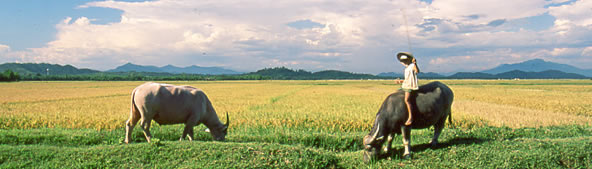
| A pastoral scene, somewhere in Indochina http://www.lotustours.net/images/backgrounds/2-column/vietnam/2.jpg |
 |
| Women on a country boat, Vietnam http://www.onthegotours.com/blog/wp-content/uploads/2011/10/BoatWomen-of-Vietnam-dreamstime.jpg |

The songs I heard when growing up were songs
that still remembered village, forest, field.
Their cadences were softer and they still
retained the sounds of water and of wind,
the calls of beasts, of insects and of birds,
of humans hailing over distances,
of lullabies, of whisperings of love,
of village dances, dirges, plaintive chants
addressed to spirits and to feeling hearts...
But now I hear the songs of industry,
the sounds of pistons and of furnaces,
the screams of engines and of humans mixed –
as both are pushed to limits – sounds of stress,
of pain, of malice and of agony –
that mimic too the sounds of modern wars –
of screaming jets, of helicopters, guns –
the thunder of the cannons, missiles, bombs –
not music this – but hell’s infernal roar.
 |
| Bombing and defoliation, Vietnam War, 1960's-1970's http://www.trueachievements.com/customimages/021715.jpg |

 |
| Women and children taking cover in a muddy ditch, Vietnam War http://unavidaenlosaromos.blogspot.com/2014_07_20_archive.html |
2015 February 25th, Wed.?
posted March 14th, Sat.
Brooklyn, New York
Subscribe to:
Posts (Atom)