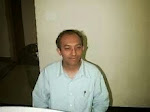
I received a letter from my cousin, Ashoke Menon Dutt, on 2016, April 12th Tue, in which he suggested that I should try to write the lyrics to a “railroad song”, set in the Indian subcontinent.
He had been inspired by a song written and first sung by the late Steve Goodman.
For most of the past thirteen years, I had been regularly sending out, to some relatives, friends and colleagues, the verses that I had been writing on a weekly and even daily basis. For the last several years, I had been posting these on my poetry blog,
The Daily Poet, and sending out the links to the posts.
However, because of many preoccupations and for some other reasons, I had stopped doing this for a while.
So I wrote back to Ashoke, saying that the “muse” appeared to have left me.
But later that night, I searched on the Internet for a “railroad song”, mistaking it first for the song “
Lord I’m one, lord I’m two … lord, I’m five hundred miles from home”. This, I found, was a song apparently written by Hedy West, in the 1960’s or earlier, assembled from melodies she had heard from her uncle in Georgia. That song has elements that reminded me of classic Negro spirituals.
Soon afterwards, I found the song Ashoke had really been referring to, “
The City of New Orleans”.
Ashoke had mentioned some things he liked about that Steve Goodman song, such as its catchy lyrics and rhythm that balanced the somewhat sad nature of the theme, which was not just about the railroad, but about the riders and more. He had also outlined what he would like for the song set in India—a human element, references to the beauty of the surroundings, the inclusion of names of places not too well known, and perhaps a long route—north-south between Kashmir and Chennai, or diagonal between Bengal and Kerala.
Unfortunately, I have neither Ashoke’s experience of those routes, nor his gift for music and song.
Nevertheless, after hearing those American songs, from recordings on the Internet, I briefly considered trying to write the words for a “railroad song” in Bengali or Hindi. I then stayed up late, into the wee hours of Wednesday morning, writing the verses in English instead.
These, reproduced below, are based on my experiences in the 1950’s, traveling with my parents and others between Kolkata (Calcutta) and
Dilli (Delhi), India’s capital city.
Whether or not the muse took it upon herself to return to help me in this, I do not know.
I omitted many historical places and interesting experiences on the route, including only a few.
For those who are not that familiar with the geography of the subcontinent and its history between the 1940's and 1970's, some information might be needed to understand the background to the verses below. This can be found in the accompanying
notes, which have pictures and maps.
But the reader may perhaps want to first read those verses. (See below.)
In the notes, I have not gone into the history of the railroads in the subcontinent, that began in the British Raj. Suffice it to note that those railroads, running thousands of miles, were built, as elsewhere, mainly by human (and animal) labor.
======================================
The Kalka Mail
I’ve ridden on a bullock cart,
I’ve ridden on an
ekka.
I rode upon a
riksho once—
And never will again.
But now we ride the Kalka Mail—
The Kalka Mail, the Kalka Mail!
And as we ride the Kalka Mail,
The night will turn to morning.
I’ve ridden on a ‘cycle and
I’ve ridden on a car.
I rode the tram to
T’aligo`nj,
The bus to
Bou Bajar.
But now we’re on the Kalka Mail,
The Kalka Mail, the Kalka Mail!
And soon we’ll be in Asansol,
The way the wheels are turning.
I go to bed within the train.
The wheels put me to sleep.
I wake to find the train has stopped,
Within a darkness deep.
I look outside—and all is dark.
The wind is softly blowing.
And in the distance, I can see
A light is softly glowing.
What could it be, I wonder as
The wheels begin to turn.
And slowly then, it slides from view—
That light within the dark.
I toss and turn and try to sleep.
The wheels are singing songs.
And yet it seems I hear, in these,
The groans from ancient wrongs.
******
Before I sleep again, I hear
“
Ça, gawrom ça!” a call
That tells me, where we’ve stopped is still
A station in Bengal.
But when I wake again, I see
The night has turned to day.
And when we stop, I hear the chant,
“
Çae, çae—garam çae!”
“
Kaavi, kaavi, kaaviya!”
I’d later hear that hail.
But that would be another trip,
Along the Deccan trail.
The dreaming hills of blue go by.
I wish that I could climb
A hillside track, towards the light
Of that
Çhot’a Nagpur sky.
******
The hills are gone, and now I see
The sun-bright plains spread wide.
The dust and grit of coal is in
My clothes and hair and eyes.
The greens by now have turned to browns.
And yet I see, at times,
The yellow mustard flowers dance
As the train goes speeding by.
“
Mughal Serai!” The “Mongol” horde
Had camped upon this site.
So this was where the horsemen once
Had rested from the fight.
And this was where the caravans
That linked the east to west,
Would halt, so horses, camels, men
Could water and could rest.
I hear this from my parents and
My eyes are opened wide.
I wonder how and why they fought—
How many then that died.
And who were they who traveled then,
To whither and from whence?
How much there is to know, I think,
And dream of
Mughal tents.
Mughal Serai! And westwards still—
And northwards, on we go!
Who laid these rails, that stretch for miles
And miles, with labor slow?
“Who laid these rails?” I ask, but then
I’m told. “You’re just a boy.
And so, this ride, upon this train,
Is what you should enjoy.”
******
I’ve ridden on a scooter and
I’ve ridden on a bike.
But riding on the Kalka Mail
Is what I really like.
The Kalka Mail, the Kalka Mail—
It thunders through the night.
From Howrah, west and north it goes,
Till
Dilli is in sight.
“How far are we from home?” I ask.
“How far is left to go?”
“We’re halfway there,” I’m told, “And that
Is all you have to know.”
“Who made these trains, who made these trains?”
“The British taught us how.
But hush! There’s people sleeping and
You’re kicking up a row!”
******
“The Kalka Mail, the Kalka Mail—
It doesn’t travel slow.
It leaves the local trains behind—
But whither does it go?”
“The Kalka Mail, the Kalka Mail--
To Kalka still can go.
But there’s a line the British drew—
And what it says is ‘No!’”
“And why is that?” I ask and see
My parents’ worried looks.
“You’ll learn the reason later, when
You’ve learned to read your books.”
I hear my mother’s answer and
I hear my father’s sigh.
“This boy of ours is curious and
He’s always asking why.”
They’re speaking now in English, as
I still can now recall.
They do not know I’m listening still—
And memorizing all.
“He doesn’t know, he doesn’t know—
He doesn’t know it yet—
Those horrors that we saw—those things
We wish we could forget.
“Those trains that never came—and all
Those bodies in our alley…
The steamer that I took, towards
The fires of
Noakhali….
“We had a dream, we had a dream.
But where did it all go?
He’s still a little boy. There’s much
He’ll sadly come to know.
“The British now have left and yet
They still receive the loot,
From those who wear the
khadi and
The ones who wear the suit.
“Perhaps the future will restore
The things that we have lost.
Perhaps we ‘natives’ still might learn
From paying such a cost.
“From Dhaka, will a train that runs
To Howrah, come to be?
From
Medinipur, he’ll go, perhaps,
To
Ça~t’ga~ then, by sea.”
I learn by heart the English words,
Although they make no sense.
I see my mother looking sad,
I see my father tense.
“Will Quetta and Peshawar be
On signs upon a train?
From
Dilli, will the mail be run
To
‘Pind’i once again?”
I hear my parents talking and
I hear my father sigh.
I do not understand and so
I idly wonder why.
******
I’ve ridden on a
phat’phat’i,
I’ve ridden on a camel.
I rode once on an elephant.
So many ways to travel!
But I prefer to walk—or else,
With
Dilli as my dream,
I ride upon the Kalka Mail
That runs on coal and steam.
“Who laid these rails, who laid these rails,
That stretch for miles and miles?”
I ask again. My mother looks
At me and only smiles.
2016 April 12th Tue night to 13th Wed morning.
(several stanzas added April 23rd Sat & May 1st, Sun)
Bensonhurst, Brooklyn, New York
======================================
Notes on "
The Kalka Mail". These notes have pictures and maps and include:
A) Place Names and Other Vocabulary (in order of occurrence in the poem) with Pictures and Maps;
B) Some Cities, States/Provinces and Regions of the Subcontinent (mentioned in the poem or its preface);
C) The Geography of the Subcontinent and the Violent Creations of Three of its Nation States.