Saturday, March 14, 2015

Music?

 
Music?
 
   
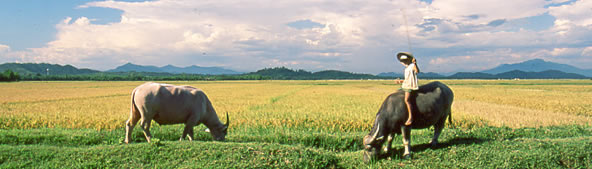
A pastoral scene, somewhere in Indochina
http://www.lotustours.net/images/backgrounds/2-column/vietnam/2.jpg


Women on a country boat, Vietnam
http://www.onthegotours.com/blog/wp-content/uploads/2011/10/BoatWomen-of-Vietnam-dreamstime.jpg


The songs I heard when growing up were songs
that still remembered village, forest, field.
Their cadences were softer and they still
retained the sounds of water and of wind,
the calls of beasts, of insects and of birds,
of humans hailing over distances,
of lullabies, of whisperings of love,
of village dances, dirges, plaintive chants
addressed to spirits and to feeling hearts...
   
******
 
But now I hear the songs of industry,
the sounds of pistons and of furnaces,
the screams of engines and of humans mixed –
as both are pushed to limits – sounds of stress,
of pain, of malice and of agony –
that mimic too the sounds of modern wars –
of screaming jets, of helicopters, guns –
the thunder of the cannons, missiles, bombs –
not music this – but hell’s infernal roar.


Bombing and defoliation, Vietnam War, 1960's-1970's
http://www.trueachievements.com/customimages/021715.jpg


Women and children taking cover in a muddy ditch, Vietnam War
http://unavidaenlosaromos.blogspot.com/2014_07_20_archive.html


2015 February 25th, Wed.?
posted March 14th, Sat.
Brooklyn, New York
   

Friday, March 13, 2015

Far Behind

 
Far Behind
   
  
Far Away on a  Long and Winding Road, North Hampshire Moors
http://dogwalkmusings.blogspot.com/2010_06_01_archive.html


When it's normal for the teachers and the nurses not to care,
Then how can those, who’re caring, not be driven to despair?
When the ones who've done the damage can then shrug and slumber deep,
Then how can those, who're trying still to fix it, hope to sleep?
When the people still are racing, when they should be paying mind,
Then where can those, who're slowing, ever be – but far behind?

******

When the madness has afflicted all the world, can then the sane
Not see that they will be the ones that others call insane?
When dishonesty's expected, can the honest then not know
That they will be suspected, wherever they may go?
When the hearts of most have hardened, can the ones of softer heart
Not understand the time has come for them to then depart?

******

There's a road, amid the moorlands, that winds through waving fields,
With sunshine and with shadow, as every fortune yields.
And on that road I'll travel as clouds go sailing by,
With none who'll care to ask me my permit or my why.
And on that road I'll dally and take my own sweet time,
For there I'll take my tally, with reason and with rhyme.
 
2015 March 13th, Fri. 2:33 am
(last stanza added March 15th, Sun.)
Bensonhurst, Brooklyn, New York
   

Thursday, March 12, 2015

The Question


The Question
  
The Question
http://engaged.robbinsbrothers.com/winner-of-seattles-ring-pop-the-question/


I asked a priest and then I asked a well-known sage the question,
“What’s the purpose of a life?” and I listened to their answers.
And afterwards I asked their wives and also asked their dinners.
And since their dinners couldn't answer, I'll answer here for them.
 
“The purpose of our living was to give the priest his dinner.”
“And our reason for existence was to feed the well-known sage.”
And how the wives had answered, I could write down here as well.
But I will not, since their curses are not fit for such a page.
 
2015 March 12th, Thu.
Brooklyn, New York
   

Monday, March 9, 2015

The Skeletons

 
The Skeletons
  
A field of daffodils, Morton Arboretum, Chicago
http://www.usa-for-me.ru/ssha/puteshesvie-v-ssha/morton-arboretum/


I saw a row of skeletons
that all appeared to grin,
it seemed as if in mockery
of the world that we are in.
 
And once again the thought occurred
that everyone has had –
that life is such a senseless thing –
beyond what’s merely sad.

And some would surely disagree
and say that life’s a blessing
or claim that there’s a purpose in it –
although it seems that's missing.

And surely I should nod my head,
to not disturb their dreams –
but still I see those skeletons
that laugh at all our themes.

******

I saw a row of skeletons
and each was once as me.
And soon enough, I too will grin
and joined with them will be.

And some will say, “We all have souls
and those will still be there.”
I gaze upon that multitude
and find it hard to bear.

Some hope for an eternity,
a heaven in the sky.
But there’s a price for everything
and more so, for a lie.

So when I end, I hope that I
will vanish and be lost.
To still be there, although I’m gone,
is far too high a cost.

Daffodil Fields, Skagit Valley, Washington, by Alan Majchrowicz
http://alanmajchrowicz.com/skagit-valley-washington-daffodil-fields/


2015 March 8th, Sun. night, late
Skyway Restaurant, Bath Avenue
(last four stanzas added the next night,
after returning home from work)
Bensonhurst, Brooklyn, New York
    

Another March


Another March
 
There’s snow upon the ground and yet the sky,
aglow in evening’s shades, has told me this –
it’s coming soon – that spring, that’s still a dream
that stirs within the winter’s slumbering.

And walking home this evening, I can see
the buds are turgid on the leafless branch –
and so, as winter’s darkness yields to light,
there wakes again that dormant, hopeful lust.

A woman has her monthly cycles and
the ones without a shelter yearly ones.
And now the season's turning and the sap
is rising slowly towards the sun and warmth.

******

How many cycles has this planet known,
how many more are left for humankind?
The snow is melting on the city’s streets,
and I have lived to see another March.

Oh sun that lights the day, oh moon and stars,
oh seasons of the year that cycle through –
you'll still be here, when I and those like me
are vanished like the snow that winter brought.

And what will other winters bring to Earth,
what other plagues that yet have music, art?
On countless planets, by the countless suns,
the seasons come – and surely then depart.
 
2015 March 9th, Mon.
Brooklyn, New York
   

Sunday, March 8, 2015

Leprechaun?

 
Leprechaun?
  
While walking in the morn, I met the mist
that still was hiding in the shadowed glen.
And though I said, “Hello!” it answered not
or in a language that I did not know.

For though I felt a breeze and just a touch
of chill that seemed to reach within my soul,
I did not linger long enough to figure out
what issued from that mist within that glen.

I fancied, as I neared the light, that there,
behind me to the right, a figure crept,
of stature small – that mist and shadows then
appeared to swallow when I turned my head.

And so I strove to hasten then my stride,
yet felt a shiver moving down my spine.
And when I stepped out in the morning light,
within a clearing, I was glad indeed.

And later, I was told, there lived within
that narrow valley, rarely touched by sun,
a being – last of those who’d lived before,
who now were gone, whilst leaving only him.
 
So was it fancy, or a living thing –
perhaps of human or of fairy kind?
I do not know, but still I will not go
again alone within that wooded glen.

2015 March 8th, Sun.
Brooklyn, New York
   

Saturday, March 7, 2015

The Races


The Races 


There’s misery in many forms – and happiness is found
in many things in many ways by you and I and more.
But let me speak awhile of woe that’s come from speeding up
and of the joy that once was here, when most were moving slow.

For Mammon wants us each to work and also spend our wages
at faster rates and more and more, expending all we've earned,
and then He wants the ant disposed before it ails and ages.
So each of us should swiftly then be buried or be burned…

For both in labor and in payments, humans serve their lords,
the ones that now we bow to, who are seated on their thrones.
So most of us are racing at our work and through our lives,
for he or she who doesn't, soon, in poverty, atones…


The more we work, the more it is that profits large are gathered.
The faster that we do it, the faster profits grow.
The more that we are spending, the more the stocks that rise.
And who can dare to posit, that all of these should slow?

But see, what all that speeding up has done to humans ‘round –
the illnesses of body, mind that also grow at speed,
the madness in the zones of peace, the madder zones of war –
and ask, “Is this what humans want or what they truly need?”

And those of conscience suffer most, while those with fewer qualms
can still survive and flourish.   So our breeds are still evolving
to be of better service to our masters, as we race
upon the treadmills that, at speed, are always now revolving.


The artisans have gone their way; the workers took their places.
And then the robots came – and those, that slaved before, displaced…
The quieter joys of life and work are lost in all our races,
and so our satisfactions are, by paychecks, now replaced…

So who has time to be with children, teach them, tell them stories?
And who has time to taste their meals, to savor still their lives –
to slowly walk, to pause to see, to read of woes and glories,
to hold another in their arms and be as husbands, wives?

For humans always knew to race, when moving fast was needed –
in hunting or in fleeing, in the battles of the past.
But we also knew of slowing – and the need for it was heeded,
for there are things we cannot do, when we’re moving fast.


The work that’s fine, that’s focused, be it that of mind or hand,
the attention that is needed, when we’re learning what is new
or pausing from our schedules to attend to those in need,
were understood to be for all – and not for just a few.

There was a time when most of us were “primitive” indeed.
We then would hunt and gather – and were truly artists each.
Our lives had woes but also joys and flowed as rivulets.
We sang and danced and worked and did our children duly teach.

And no, it was no paradise, but yet we each were free
of masters who could make us work and rob us of our labor.
For we were truly humans then, in all our little clans.
The quiet joys of human lives, we then could truly savor.


No clock-alarms, no rushing then to work in soulless mills,
not even fields, by brigands owned, to whom we owed their share –
no landlords then to claim their rents, no trace of feudal ills,
no “paradise on earth” and yet – a life that we could bear.

For we had friendships then – and bonds.  We cried at deaths, departures.
We laughed aloud and smiled a lot, we joked and had our fun.
No hospitals or nursing homes – and yet we did our best
to care for those who needed care – until the setting sun.

And those, who first then tilled the land, enjoyed awhile their grain,
and so could settle down and tend to elders and the sick.
But then there came the bandits who became their masters and
who put in place their feeding chains from populations thick.


So predators can feed off prey, when prey becomes abundant.
So just as men had “tamed” the beasts and set them then to toil,
so also men were tamed in turn, so others then could feed
on all the work that peasants did upon the yielding soil.

And then the cities, then the trades, the ships and factories –
and so the trek towards the towns, to work in dreary mills,
and then the start, towards the end of all that humans had
that can’t be bought.  And so the starts of many present ills.

So having told this history, however poorly, I
would now beseech you to observe and question what you do.
For only when such attitudes are prevalent will we
return perhaps to slower lives – as meant for me and you.


For those conditioned by their times – this age of packaging
and those that came before – they rarely pause to question why.
But to survive and to “succeed”, they quickly learn to race,
and so their lives become  a blur.  They never see the lie.

And only when the lies that we are fed, from when we’re born,
are seen for what they are, will men and women start to stop
and question wars of arms and those that now are waged in “peace” –
in all the races that consume our lives, until we drop.
 
2015 March 7th, Sat.
Brooklyn, New York